
Lectio Divina & The Pillar of Prayer

(BEEP! BEEP! BEEP!) The alarm sounds, and another day of balancing competing responsibilities begins. Some days unfold with surprising ease. Other days feel like juggling flaming swords while blindfolded on a unicycle rolling downhill. We have all been there.
Between the demands of full-time work, the gift and responsibility of raising children, and the sacred task of marriage, Lay Dominican life also includes the Mass, praying the Rosary, the Liturgy of the Hours, attending fraternity meetings, and participating in apostolates. How do we hold these daily obligations together with our promises as Lay Dominicans to participate in our pillar of prayer?
This is the tension we live with: the need to engage with the unchanging truth of God’s Word while being pulled in many directions by life's obligations. How can we create a sanctuary of quiet connection to the Lord in a cacophony so often wrought by noise? One answer is to reclaim our focus through a rhythm of steady, Scripture-rooted communion with the Lord. An ancient practice that fits with this goal within the context of our pillar of prayer is Lectio Divina (Divine Reading).
Lectio Divina is a prayerful way of reading Scripture that moves from attentive listening to meditation, prayer, and contemplation, so that God’s Word can mold our hearts and our daily lives.1 This is fundamental because, "The word of God is living and active, sharper than any two-edged sword..."2
Historically, Lectio Divina emerged from the early monastic tradition of the Church and was later shaped in the West by figures such as St. Benedict of Nursia.3 Lectio Divina, over the centuries, developed a four-part structure that loosely guides the experience.4 These Western monastics helped conserve Lectio Divina as an exacting yet intimate method of listening to God’s Word and allowing it to form the heart. St. Ephrem the Syrian puts it so beautifully:
"Lord, who can grasp all the wealth of just one of your words? What we understand is much less than we leave behind, like thirsty people who drink from a fountain. For your word, Lord, has many shades of meaning just as those who study it have many different points of view. The Lord has colored his word with many hues so that each person who studies it can see in it what he loves. He has hidden many treasures in his word so that each of us is enriched as we meditate on it.”5
In my experience, Lectio Divina is a conversation with the Lord through Sacred Scripture, not an intellectual exercise or a formula for baking the perfect spiritual cake. Its purpose is communion with God: listening for His voice and responding in grace. Like Elijah, who encountered the Lord not in the fire but in “a gentle whisper,”6 I must prepare my soul to hear Him.
Below are the steps to Lectio Divina. While there are many resources for this in the Church, I am focusing on putting them in “elevator pitch form” in my own words for simplicity. They do not require scrupulous adherence.
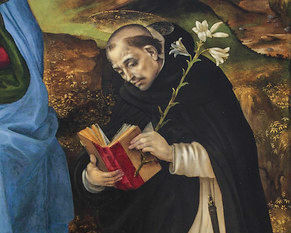
1. Lectio:
I choose a short passage from the Gospel reading for the day, a section of the psalms, or a selection from the Office of Readings. I read it slowly, sometimes aloud when my mind is distracted. The goal is to let the words sink in. I repeat this a few times, listening for a word or phrase that catches my attention or “speaks” to me.
2. Meditatio:
In this step, I take the word or phrase that spoke to me and repeat it silently in my heart. I ruminate on it. This step is about allowing the Holy Spirit to connect that word or phrase to my life. I use the word “ruminate” specifically here, as some Church Fathers used ruminating animals as a great analogy for “chewing on scripture.” Take St. Augustine, for example, when he writes:
“The animal (the pig) is pronounced unclean by the law, because it does not chew the cud... But the men of whom this animal is a symbol are unclean, not by nature, but from their own fault; because, though they gladly hear the words of wisdom, they never reflect on them afterward. For to recall, in quiet repose, some useful instruction from the stomach of memory to the mouth of reflection, is a kind of spiritual chewing of the cud."7
3. Oratio:
Here I respond to God based on what I have encountered. I pray and converse with the Lord. This is the time when my reading turns into a prayerful conversation. Perhaps the verse I have read highlights a virtue that I need help in cultivating. I will pray for the grace to practice that virtue and help look for defects in my character where that virtue is not present.
4. Contemplatio:
I must admit this step is the most profound and even elusive for me. Even so, I sit in the presence of God anyway. I just rest, knowing that God is with me and that somehow, I am being transformed in His grace. I must work at preparing my soul through habit and be faithful to seeking Him each day in His word. But I’ve learned that it isn’t prudent to try to manufacture spiritual consolation out of my own self-will.
For Lay Dominicans, who uphold the Order of Preachers' pillar of prayer while remaining fully engaged in the world, Lectio Divina is a useful practice that allows us to experience God through his Word and to spread the Gospel in the realities of daily life. After all, the Dominican family is committed to the charism,“contemplata aliis tradere - to hand on to others the fruits of contemplation.”8 I’m reminded that when the piercing alarm starts my day, I can find my Bible and begin Lectio Divina, filling my soul with the Word of God rather than starting with my cell phone, calendars, and spreadsheets.
1 Guigo II. The Ladder of Monks and Twelve Meditations. Translated by Edmund Colledge and James Walsh. Kalamazoo, MI: Cistercian Publications, 1979.
2 Hebrews 4:12 (Revised Standard Version, Catholic Edition)
3 Benedict of Nursia. The Rule of St. Benedict. Translated by Leonard J. Doyle. Collegeville, MN: Liturgical Press, 1948.
4 Inside TheVatican. “Lectio Divina.” Accessed July 4, 2026. https://insidethevatican.com/magazine/culture/books/a-guide-to-lectio-divina/
5 Ephrem the Syrian, Commentary on the Diatessaron, 1.18–19, in Sources Chrétiennes 121, 52–53.
6 1 Kings 19:11–13 (New International Version)
7 Augustine, Expositions on the Book of Psalms, Psalm 80, in Nicene and Post-Nicene Fathers, First Series, vol. 8, trans. J. E. Tweed.
8 Thomas Aquinas, Summa Theologiae, II-II, q. 188,art. 6, trans. Fathers of the English Dominican Province. Note: The Latin line is often rendered: “Just as it is better to enlighten than merely to shine, so it is better to give to others the fruits of one’s contemplation than merely to contemplate.”
Nicholas Foster made his Perpetual Profession as a Lay Dominican in 2020. He is President of the St. Catherine of Siena Fraternity in Carmel, IN. His Fraternity's Apostolate is teaching and preaching about and praying for the dead.
"I knew I was meant to be a Lay Dominican because of my undeniable attraction to the 4 pillars of the Dominican life, namely, prayer, study, community, and preaching. When I'd study the lives of Dominican Saints, it felt like a homing device in my heart was activated and leading me to proclaim the Gospel in my ordinary daily life and to seek and share the truth."